

How much will my pension be worth at retirement? 4 pension questions to ask
Written: 12 November 2026. Updated: 18 November 2026
Key takeaways:
- Calculating how much your pension pot could be worth at retirement can be complex, with multiple variables to consider.
- Consolidating your pensions could deliver a variety of benefits, but may not be suitable in all circumstances.
- You can usually claim tax relief on contributions at your marginal rate, up to the value of your annual earnings.
- Paying into someone else’s pension could be a tax-efficient way to help a loved one grow their retirement savings.
Whether you’re just starting to get your head round pensions or reviewing ahead of retirement, understanding how to make the most of your pension can be complex.
It’s not a straightforward matter of saving into a big pot of cash. You also need to consider investment growth, scheme fees, and tax relief.
You might be conscious that you need to take control of your pension and start planning for retirement, but unsure of where to begin and what questions to ask.
To help you get started, here are four questions to ask about your pensions.
1. What will my pension be worth at retirement?
You might have paid into your pension throughout your career and assumed it will be enough to support you in retirement. But without understanding how much you’re currently on track to have set aside in a pension, you could risk reaching retirement without the funds you need.
Forecasting your pension pot’s value is a complex calculation, with numerous variables to consider, including:
- The amount saved so far across all your pension pots
- Your own contribution rate
- Your employer’s contribution rate
- Potential future changes to your income (such as pay rises and career breaks)
- Investment growth rates, taking different scenarios and risk levels into account
- When you plan to retire.
Remember: as your pot grows, inflation can erode its spending power. So, your pension’s projected value may not be worth as much at retirement as it is in today’s money.
A financial planner can support you in completing these complex calculations, taking all relevant variables into account to understand your different possible outcomes. Armed with this information, you can then determine whether you need to take action to grow your pot quicker.
Read more: Guide to Retirement Planning
2. Should I consolidate my pensions?
Throughout your career, you may have accumulated multiple defined contribution (DC) pensions. Whenever you get a new job, your employer will sign you up to their scheme, leaving your previous workplace pension behind.
Depending on your circumstances, consolidating these pots could deliver numerous benefits, such as:
- Simplifying your pension admin, both before and during retirement
- Reducing your fees to keep more of your money invested in your pension
- Giving you more flexibility over your investment choices
- Making it easier for your executor to settle your estate after you pass away.
However, consolidation may not be suitable in all circumstances. Transferring funds out of a defined benefit (DB) scheme is not usually recommended.
Consolidation is often irreversible and therefore requires careful planning. Otherwise, you could lose out on valuable benefits, growth opportunities, or tax-efficient withdrawal options. A financial planner can help you devise a suitable consolidation strategy to support your goals.
Read more: Should you combine your pensions? 8 factors to consider before consolidating
3. How can I claim tax relief on pension contributions?
Generally, pension contributions are topped up at your marginal rate of Income Tax.
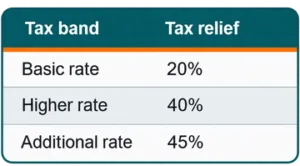
Tax relief is typically applied at the basic rate automatically (known as relief at source). Higher- and additional-rate taxpayers may be able to claim the extra 20% or 25%, respectively, through Self Assessment.
However, it’s important to note that tax relief is limited to contributions up to the value of your annual earnings. What’s more, contributions above the Annual Allowance (£60,000 in 2026/27) may be subject to a tax charge – effectively negating the benefit of tax relief.
In some cases, your Annual Allowance may be lower, such as if you have flexibly accessed your pension or are a high earner.
Read more: The power of pension tax relief and how it could boost your retirement income
4. Can I pay into someone else’s pension?
You can make direct payments into another person’s pension, such as your spouse, child, or anyone else.
Third-party pension contributions can be a tax-efficient way to help a loved one grow their retirement savings. For instance, if your partner takes a career break to have a baby, you could continue paying in on their behalf.
Tax relief will typically be added directly to their pot at 20%, and they may be able to claim more if they’re a higher- or additional-rate taxpayer.
If the pension holder doesn’t work, such as if they’re a child or a stay-at-home parent, 20% tax relief will usually be added to contributions up to £2,880 a year.
Read more: 4 practical reasons to regularly contribute to your child’s pension
A few key things to remember here:
- Your contributions will count towards the recipient’s annual tax relief limits, rather than your own.
- As described above, tax relief will normally only be available on contributions up to the value of the pension holder’s annual income, with a tax charge applying once they exceed the £60,000 Annual Allowance.
It’s important to note that some pension providers may not accept direct contributions from third parties. So, before making a payment, it’s worth checking with the recipient that:
- Your contribution will not push them over their annual tax relief limits
- Their pension provider allows direct contributions.
Payments into a pension other than your own or your spouse or civil partner’s may be treated as gifts for Inheritance Tax purposes. As such, it’s wise to consult a financial planner to understand the potential implications for your estate’s tax bill when you pass away.
Read more: When Inheritance Tax could apply to gifts
Get in touch
At Fiducia Wealth, our Chartered financial planners can help you learn everything you need to know about your pension – from its projected value at retirement to how you can accelerate its growth.
Working closely with you to understand your circumstances, goals, and priorities, we can create a retirement plan that’s tailored to you.
Email us at email@fiduciawealth.co.uk or call us on 01206 321 045 to find out how we could support you.
Want to learn more about working with Fiducia? Discover 5 important reasons why over 90% of our clients recommend us
Please note
This article is for general information only and does not constitute advice. The information is aimed at individuals only.
All information is correct at the time of writing and is subject to change in the future.
Please do not act based on anything you might read in this article. All contents are based on our understanding of HMRC legislation, which is subject to change.
A pension is a long-term investment not normally accessible until 55 (57 from April 2028). The fund value may fluctuate and can go down, which would have an impact on the level of pension benefits available. Past performance is not a reliable indicator of future performance.
The tax implications of pension withdrawals will be based on your individual circumstances. Thresholds, percentage rates, and tax legislation may change in subsequent Finance Acts.
Workplace pensions are regulated by The Pensions Regulator.