

4 HMRC-approved gifting strategies to cut your Inheritance Tax bill
Written: 21 August 2026. Last Updated: 26 August 2026.
Key takeaways:
- Giving assets away can help reduce the size of your estate and Inheritance Tax (IHT) bill.
- The Office for Budget Responsibility (OBR) forecasts that IHT receipts will continue rising over the next few years, meaning more of your wealth could go to HMRC.
- Gifts made within the seven years before your death may still be included in IHT calculations.
- Making the most of HMRC’s gifting exemptions can help remove assets from your estate immediately.
- Gifts made from your surplus income may be exempt from IHT.
- Placing assets in trust could help set funds aside for loved ones, while mitigating your estate’s IHT liability.
When you die, you will likely leave an inheritance to those named in your will. Unless they are your spouse or civil partner, beneficiaries – those who receive your money and assets – could be liable to pay IHT on the amount they receive.
Inheritance Tax bills are rising. Giving money away now could help
Financial gifting can be an effective tool for cutting your estate’s IHT bill. According to the OBR, IHT receipts are expected to rise from £8.3 billion in 2024/25 to £14.5 billion by 2030/31. So, without taking proactive steps to mitigate your estate’s bill, you could find a larger portion of your wealth becomes taxable over the next few years.
Learn more by reading our estate planning guide.
But it’s not simply a case of giving cash away. The value of your gifts could still be included in IHT calculations after you die if they don’t qualify for an exemption.
HMRC’s rules are complicated and it’s easy to be caught unawares. By using these four gifting strategies, you can help reduce the chances of your gifts being liable for IHT when you pass away.
Strategy 1: Give funds away early in life
There are no legal restrictions on the amount of your wealth you can give away – either gradually throughout your lifetime or as a one-time gift.
However, if you die within seven years of giving a gift, the value may still be included in your estate for IHT purposes. These gifts are known as “potentially exempt transfers” (PETs) and may qualify for taper relief, which is when gifts exceeding your nil-rate band are subject to a lower IHT rate if you survive a certain amount of time after making them.
In 2026/27, the nil-rate band is £325,000, or up to £500,000 if you benefit from the residence nil-rate band.
Gifts above this threshold may be taxed as follows:
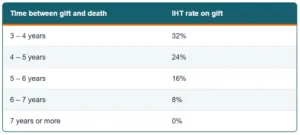
Explained: When Inheritance Tax could apply to gifts
The sooner you give funds away, the more likely you are to outlive the seven-year period.
This could significantly reduce the size of your estate, passing more wealth to loved ones while mitigating your estate’s IHT liability.
That said, it’s important to carefully consider how much money you can afford to give away. You need to ensure you keep hold of enough funds to last throughout the rest of your lifetime, accounting for long-term goals, retirement, and the potential need for care later in life.
As such, if you’re considering gifting large sums earlier in life, it’s worth consulting with a financial planner to ensure you’re not sacrificing your own financial stability in order to reduce an IHT bill.
Strategy 2: Make the most of your gifting exemptions
While some gifts may be potentially liable for IHT for up to seven years, others may be immediately exempt from IHT.
Annual exemption
As of 2026/27, the annual exemption allows you to gift up to £3,000 without being subject to the seven-year rule. The value is removed from your estate immediately, meaning it won’t be counted in IHT calculations when you die.
You can carry forward any unused annual exemption by up to one tax year, provided you use the current year’s exemption first. As such, you may be able to gift up to £6,000 tax-efficiently in 2026/27.
What’s more, if you’re in a couple, you and your partner have separate allowances. By combining them, you could gift up to £6,000 in 2026/27, or £12,000 if you haven’t used any of your 2025/26 allowance.
Wedding gift allowance
The wedding gift allowance allows you to make tax-efficient gifts when someone gets married or enters a civil partnership. The amount you can gift while having the value immediately removed from your estate depends on your relationship with the recipient.

If you’re in a couple, you and your partner have your own allowances – meaning you could potentially double your tax-efficient wedding gifts by combining your allowances.
Small gift allowance
You can normally give up to £250 a year per person to an unlimited number of recipients, provided you don’t also use the annual exemption or wedding gift allowance on the same person.
By using these gifting allowances strategically over several years, you could significantly reduce the value of your estate – and your IHT bill – without the risk of the gifts being liable for IHT when you die.
Strategy 3: Use your surplus income for financial gifting
You can gift an unlimited amount of your normal income without using up your tax-efficient gifting allowances or being subject to the seven-year rule.
Gifts from surplus income must meet HMRC’s criteria to qualify as “normal expenditure out of income”:
- You can continue meeting your usual living costs in addition to the regular gifts
- You make the payments from your regular income, rather than from savings.
For example, you might:
- Regularly support your adult child with rent
- Pay into your child’s Junior ISA or pension
- Support an elderly relative with care costs
Provided the payments are regular and meet the criteria above, they will normally be excluded from your estate when it comes to calculating IHT.
You can still use your annual exemption and wedding gift allowance on the same recipient as your regular gifts; however, you cannot combine regular gifting with the small gift allowance.
When you pass away, your executor will need to demonstrate that these payments qualify for the gifting exemption. As such, it’s wise to keep accurate, up-to-date records of your gifts and ensure your executor can find them when the time comes to settle your estate.
Strategy 4: Put assets in trust to hold them outside your estate
While gifting can be an effective strategy for mitigating an IHT bill, there are various reasons you might not feel ready to gift just yet.
For example, if your chosen beneficiary is a child, or you intend for the funds to be used for a particular purpose, you might wish to wait before giving them access to the money.
Trusts are highly complex structures, and you’ll need to obtain professional advice when setting one up.
For now, here are four things to remember:
- By placing the funds in a trust, you can set them aside for your loved one – and remove them from your estate – without needing to hand over the funds immediately.
- Depending on the type of trust you choose, IHT may still be charged, but at a lower rate.
- There are a wide variety of trust types available, each with its own rules for tax, access, and ownership.
- Once you have placed funds in trust, you generally can’t remove them. As such, it’s wise to consult with a financial planner before making any irreversible decisions.
Find out how our estate planning and IHT services could support you.
Our Chartered financial advice firm in Essex is here to support you
The problem of IHT is unlikely to go away any time soon – but you can maintain control of how much your family has to pay.
At Fiducia, our financial planners can support you in creating a gifting plan that helps mitigate your estate’s IHT bill without compromising your financial circumstances and goals.
Email us at email@fiduciawealth.co.uk or call us on 01206 321 045 to find out how we could support you.
Want to find out more about working with Fiducia? Discover why over 90% of our clients would recommend us to family and friends.
Please note
This article is for general information only and does not constitute advice. The information is aimed at individuals only.
All information is correct at the time of writing and is subject to change in the future.
Please do not act based on anything you might read in this article. All contents are based on our understanding of HMRC legislation, which is subject to change.
The Financial Conduct Authority does not regulate estate planning, tax planning, trusts, or will writing.
Remember that taper relief only applies to gifts in excess of the nil-rate band. It follows that, if no tax is payable on the transfer because it does not exceed the nil-rate band (after cumulation), there can be no relief.
Taper relief does not reduce the value transferred; it reduces the tax payable as a consequence of that transfer.